New York Close Charts in Forex: What They Are and Why They Matter
By The Forex Trading Coach Review Editorial Last reviewed: 7 Oct 2026
Short answer
What 'New York close' means
Forex trades across time zones, so a charting platform has to choose a server time for grouping prices into candles. A New York-close chart treats 5pm New York time as the boundary between one trading day and the next. The new daily candle opens as the previous one closes.
The label describes chart construction, not a moment when the worldwide currency market shuts completely. Prices continue into the next trading day. The important point for analysis is that every daily candle uses the same recognised boundary.
Five daily candles vs six
A normal trading week has five New York-close daily candles. A platform whose server clock divides the week differently may print a small Sunday candle between the weekly open and its next daily boundary. The same price history is then divided into six shapes instead of five.
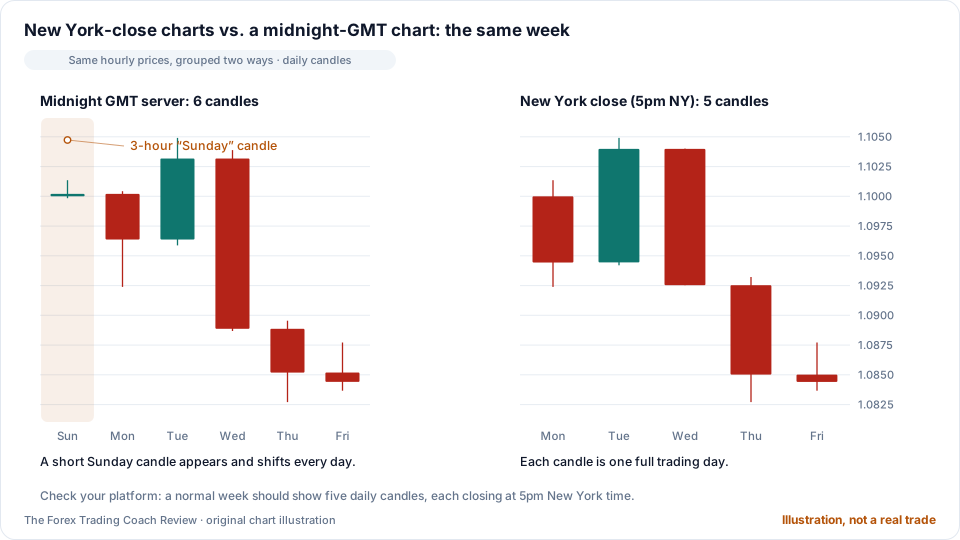
That extra candle can change the apparent open, high, low and close of the neighbouring candles. A textbook pattern may therefore look different on two platforms even though both received similar prices. Consistency matters more than treating one isolated shape as certain.
How to check your platform
Open a daily chart and count the candles in a complete trading week. Five full daily candles are consistent with a New York-close layout; a small sixth Sunday candle shows that the server is dividing the week differently.
Next, note the platform time when a daily candle closes and convert it to New York time. Check this again when daylight-saving clocks change, because the difference between your local time, New York time and the broker server may shift. Platform support can explain the server clock if it is unclear.
Why it matters for higher-timeframe traders
Daily, 12-, 8-, 6- and 4-hour candles can all be organised around the 5pm boundary. That means a scheduled check-in can cover several completed higher-timeframe charts instead of requiring continuous monitoring.
It also makes notes and chart examples easier to compare when every day is divided in the same way. It does not ensure that two brokers show identical highs and lows, and it does not make any pattern predictive by itself.
TFTC posts daily trade ideas for members around 5:30pm EST, after the New York close. You can read our full review of its support and community for the public facts we checked.
How this fits a part-time routine
A fixed close creates a natural appointment with the charts. A part-time trader can review the completed daily candle, scan the higher timeframes that have also closed, update a plan and then step away. The routine is defined by completed information rather than spare moments during the day.
If 5pm New York falls at an inconvenient local time, another higher-timeframe close may fit better. The practical goal is a repeatable schedule that protects work and sleep. Missing a check should not lead to chasing a price after the planned moment has passed.
Practise the routine on a demo account first. Record the chart time, your local time and which candles were complete so timing errors become visible before capital is at risk.