Set-and-Forget Forex Trading: What It Means and Who It Suits
By The Forex Trading Coach Review Editorial Last reviewed: 7 Oct 2026
Short answer
What set-and-forget actually means
Set-and-forget is a way of executing a plan, not a trading system by itself. Before placing anything, a trader decides where an order may enter, where a losing trade will be closed and where a profitable trade may be closed. Those decisions are translated into orders rather than left for later.
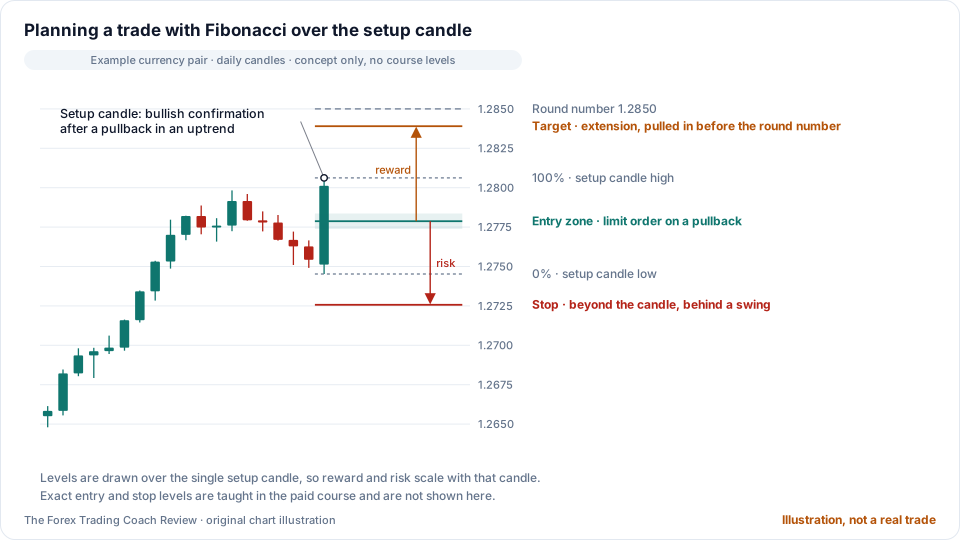
Once the order is placed, the trader does not repeatedly interfere because of every small price movement. The point is to separate analysis from emotion. It does not mean forgetting the account, skipping routine checks or assuming the broker will always fill an order at the exact requested price.
The approach can be used with many general methods. What matters is that the whole idea is planned before exposure begins and that the possible loss is acceptable.
How pending orders make it possible
A pending order waits until the market reaches a chosen level. A limit order is normally used when the trader wants to buy below the current price or sell above it. A stop order is normally used to buy above the current price or sell below it. These are standard order types, but names and execution details can differ by platform.
A stop-loss can be attached to close the trade if price moves against it. A take-profit can be attached to close it at a planned target. Planning all three levels also lets the trader calculate position size from the distance to the stop before submitting the order.
Why people with jobs like it
The obvious benefit is less screen time. A person can review completed candles at a scheduled time, place an order if the plan allows one, and return to work or family commitments. That is different from following every tick or trying to react during a meeting.
It can also reduce spur-of-the-moment decisions. The entry, stop and target are chosen while the trader is calm, rather than after price starts moving quickly. Waiting for a candle to close avoids making a decision from a shape that may disappear before the period ends.
People who value this kind of routine may also want our top pick for support and a community, where the emphasis is on having help rather than trading alone.
The risks people underplay
Orders reduce the need to watch, but they cannot make markets predictable. Weekend gaps can move price past a stop before trading resumes. Important news can produce a fast spike, a wider spread or slippage. A stop may therefore be filled at a worse price than planned.
A pending entry may also fill during a move that has changed the original market context. Traders need a clear policy for expiring or reviewing old orders. The existence of a stop does not justify an oversized position.
Most importantly, set-and-forget does not create hands-off income. Trades can lose, losing runs happen, and an account still needs oversight. It is a practical scheduling method, not a promise of results.
How to practise it
Start on a demo account so you can learn how each order behaves without risking capital. Write down the planned entry, stop, target and reason before placing it. Keep the risk small and fixed from one example to the next so the journal compares decisions rather than changing bet sizes.
- Check whether the platform accepted every attached order.
- Record gaps, slippage and cancelled or expired orders.
- Review the journal once a week instead of changing the process after one result.
- Move to real capital only if you understand the mechanics and can afford the risk.
Practice should test whether the routine fits your life as well as whether the ideas make sense. A method that requires checks you cannot reliably make is not genuinely set-and-forget for you.